The National Gallery fronts Trafalgar Square with a beautiful building for displaying art. The collection spans the range from old masterpieces (Biblical themes, yawn) to the impressionists (Cezanne, Monet, Seurat). You'll find no abstracts here, well, unless I missed a room in the museum's maze of similar-looking but luxurious spaces.
The six paintings I've photographed and posted below were each chosen for a reason: two are for the fan of Caravaggio; the two Dutch pieces for their photograph-like detail; the Arsenale because Paul and I have spent a fair amount of time there; and I do love a good mountain-and-meadow scene.


Michelangelo Merisi da Caravaggio (1571-1610)
The Supper at Emmaus, 1601
After his Resurrection, Christ walked to Emmaus with two disciples. The men only recognised him when they dined together and Christ blessed the bread (Luke 24), as he had done at the Last Supper. The inn-keeper stands behind Christ. One disciple starts out of his chair while the other throws his arms wide in astonishment. This disciple wears a shell, the emblem of a pilgrim. Oil and tempera on canvas
Michelangelo Merisi da Caravaggio (1571-1610)
The Supper at Emmaus, 1601
After his Resurrection, Christ walked to Emmaus with two disciples. The men only recognised him when they dined together and Christ blessed the bread (Luke 24), as he had done at the Last Supper. The inn-keeper stands behind Christ. One disciple starts out of his chair while the other throws his arms wide in astonishment. This disciple wears a shell, the emblem of a pilgrim. Oil and tempera on canvas
Michelangelo Merisi da Caravaggio (1571-1610)
The Supper at Emmaus, 1601
After his Resurrection, Christ walked to Emmaus with two disciples. The men only recognised him when they dined together and Christ blessed the bread (Luke 24), as he had done at the Last Supper. The inn-keeper stands behind Christ. One disciple starts out of his chair while the other throws his arms wide in astonishment. This disciple wears a shell, the emblem of a pilgrim. Oil and tempera on canvas

Michelangelo Merisi da Caravaggio (1571-1610)
Salome receives the Head of John the Baptist, about 1609-10
When Salome was granted a wish by King Herod, she asked for the head of John the Baptist (Mark 6). Although often shown triumphant, here Salome turns away from the grisly sight. This work was painted after Caravaggio was forced to flee Rome for killing a man.
Michelangelo Merisi da Caravaggio (1571-1610)
Salome receives the Head of John the Baptist, about 1609-10
When Salome was granted a wish by King Herod, she asked for the head of John the Baptist (Mark 6). Although often shown triumphant, here Salome turns away from the grisly sight. This work was painted after Caravaggio was forced to flee Rome for killing a man.
Michelangelo Merisi da Caravaggio (1571-1610)
Salome receives the Head of John the Baptist, about 1609-10
When Salome was granted a wish by King Herod, she asked for the head of John the Baptist (Mark 6). Although often shown triumphant, here Salome turns away from the grisly sight. This work was painted after Caravaggio was forced to flee Rome for killing a man.


Jan van der Heyden (1637-1712)
View of the Westerkerk, Amsterdam, probably 1660
In this architectural townscape, minute brushstrokes render precise details, from the leaves of trees to terracotta brickwork. Van der Heyden's method was particular: he completely painted in the facades of buildings that were later to be obscured by the greenery. The artist was also a respected inventor and engineer.
Jan van der Heyden (1637-1712)
View of the Westerkerk, Amsterdam, probably 1660
In this architectural townscape, minute brushstrokes render precise details, from the leaves of trees to terracotta brickwork. Van der Heyden's method was particular: he completely painted in the facades of buildings that were later to be obscured by the greenery. The artist was also a respected inventor and engineer.
Jan van der Heyden (1637-1712)
View of the Westerkerk, Amsterdam, probably 1660
In this architectural townscape, minute brushstrokes render precise details, from the leaves of trees to terracotta brickwork. Van der Heyden's method was particular: he completely painted in the facades of buildings that were later to be obscured by the greenery. The artist was also a respected inventor and engineer.

Pieter de Hooch (1629-1684)
The Courtyard of a House in Delft, 1658
The tablet above the archway was originally over the entrance to the Hieronymusdale Cloister in Delft. It translates: This is in Saint Jerome's vale, if you wish to withdraw to patience and meekness. For we must first descend if we wish to be raised.' De Hooch is best known for his Delft-period paintings of orderly interiors and sunny courtyards.
Pieter de Hooch (1629-1684)
The Courtyard of a House in Delft, 1658
The tablet above the archway was originally over the entrance to the Hieronymusdale Cloister in Delft. It translates: This is in Saint Jerome's vale, if you wish to withdraw to patience and meekness. For we must first descend if we wish to be raised.' De Hooch is best known for his Delft-period paintings of orderly interiors and sunny courtyards.
Pieter de Hooch (1629-1684)
The Courtyard of a House in Delft, 1658
The tablet above the archway was originally over the entrance to the Hieronymusdale Cloister in Delft. It translates: This is in Saint Jerome's vale, if you wish to withdraw to patience and meekness. For we must first descend if we wish to be raised.' De Hooch is best known for his Delft-period paintings of orderly interiors and sunny courtyards.
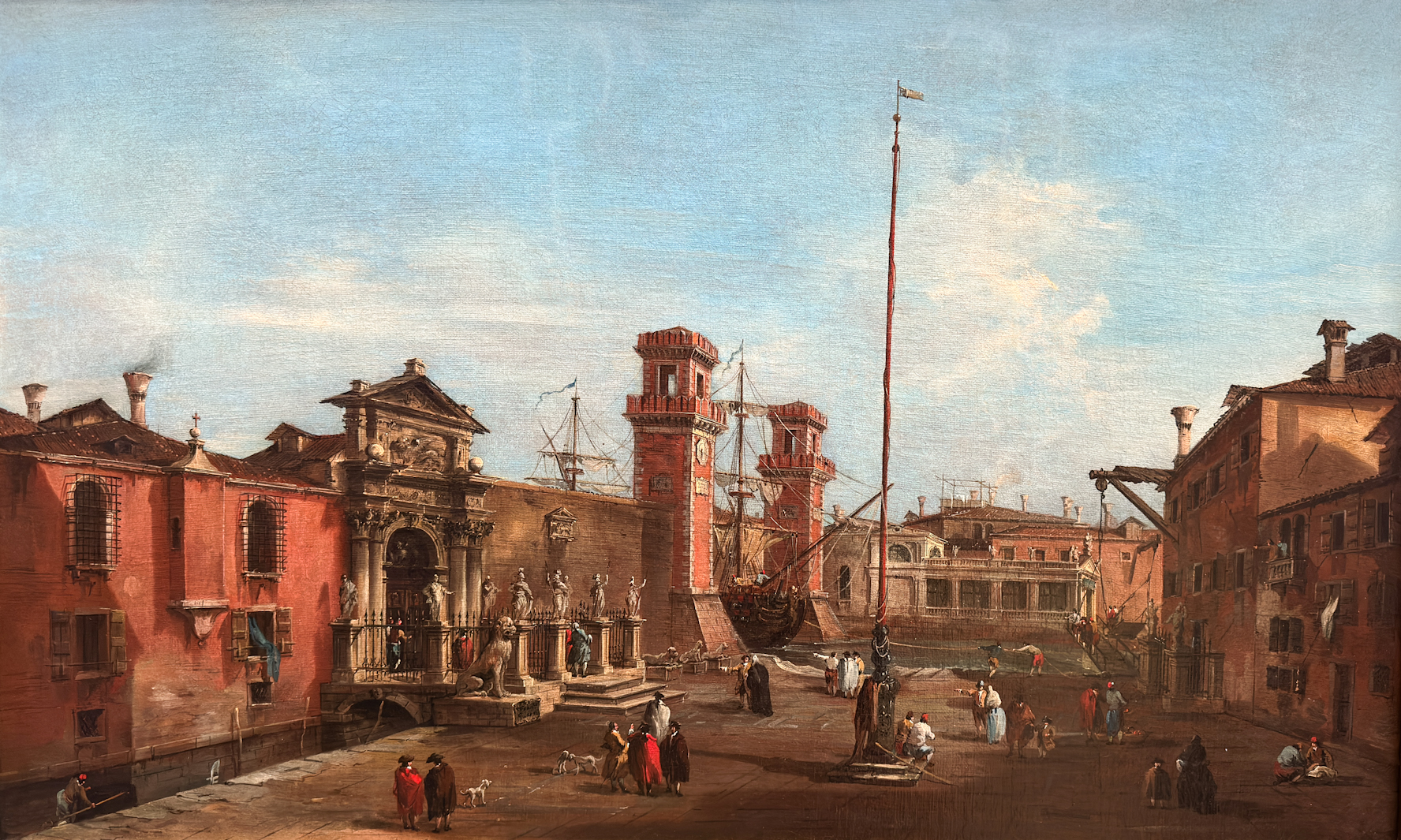
Francesco Guardi (1712-1793)
Venice: The Arsenal, 1755-60
The Arsenal was where the ships of Venice's powerful fleet were built. Its main gateway is on the left. A boat passes between two towers beyond, and the chapel of the Madonna dell'Arsenale is visible across the canal. Based on an engraving by another view-painter, this is one of Guardi's earliest views and among the less well-known sights of Venice.
Nowadays the Arsenale spends much of the year hosting the Venice Biennale, which we visited in 2019 and 2022.
Francesco Guardi (1712-1793)
Venice: The Arsenal, 1755-60
The Arsenal was where the ships of Venice's powerful fleet were built. Its main gateway is on the left. A boat passes between two towers beyond, and the chapel of the Madonna dell'Arsenale is visible across the canal. Based on an engraving by another view-painter, this is one of Guardi's earliest views and among the less well-known sights of Venice.
Nowadays the Arsenale spends much of the year hosting the Venice Biennale, which we visited in 2019 and 2022.
Francesco Guardi (1712-1793)
Venice: The Arsenal, 1755-60
The Arsenal was where the ships of Venice's powerful fleet were built. Its main gateway is on the left. A boat passes between two towers beyond, and the chapel of the Madonna dell'Arsenale is visible across the canal. Based on an engraving by another view-painter, this is one of Guardi's earliest views and among the less well-known sights of Venice.
Nowadays the Arsenale spends much of the year hosting the Venice Biennale, which we visited in 2019 and 2022.

Ferdinand Hodler (1853-1918)
The Kien Valley with the Bluemlisalp massif, 1902
A key figure of modernism, the Swiss artist Ferdinand Hodler spent summer 1902 painting mountain views. "The landscape must have a character," - he wrote - "express a passion or emotion". This picture - with its insistent verticality, defined fields of colour and ornamental, decorative clouds - conveys a sense of timelessness and meditative stillness.
Ferdinand Hodler (1853-1918)
The Kien Valley with the Bluemlisalp massif, 1902
A key figure of modernism, the Swiss artist Ferdinand Hodler spent summer 1902 painting mountain views. "The landscape must have a character," - he wrote - "express a passion or emotion". This picture - with its insistent verticality, defined fields of colour and ornamental, decorative clouds - conveys a sense of timelessness and meditative stillness.
Ferdinand Hodler (1853-1918)
The Kien Valley with the Bluemlisalp massif, 1902
A key figure of modernism, the Swiss artist Ferdinand Hodler spent summer 1902 painting mountain views. "The landscape must have a character," - he wrote - "express a passion or emotion". This picture - with its insistent verticality, defined fields of colour and ornamental, decorative clouds - conveys a sense of timelessness and meditative stillness.